This week, I came across an article in the San Francisco Gate (which, incidentally, has really ramped up its forex coverage over the last year) that addressed this very topic. Given that part-time forex traders probably outnumber those that practice the craft full-time, such an article was long overdue.
In sum, the author advises part-time traders to concentrate their trading during the busiest times of the day, or failing that, to simply trade the most active currency pairs during the period of the day that one happens to have time to trade. For example, if you wish to trade the USD/EUR but only have a limited amount of time to do so, you are advised to trade the opening of the New York and/or London sessions, at 8AM EST and 3AM EST, respectively. Alternatively, if you only have time to trade from midnight to 2am, for example, you are advised to trade currency pairs in which the quote currency is the Yen, because during that time the Tokyo session is “in full swing.”
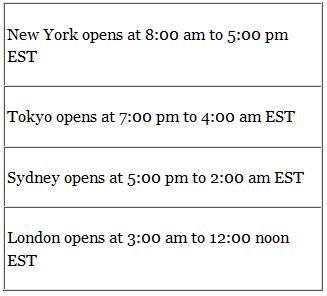
Alas, this kind of strategy is based on a very dubious assumption, which is that you should aim to trade the currency pairs which are both the most liquid and most volatile (ignore the contradiction here), because this will yield the most profits. In other words, it’s easy to capture profits when trading pairs that tend to bounce around a lot and which are cheap and easy to buy and sell. Right?
If you read the Forex Blog with any regularity and are ware that my bend is towards fundamental analysis, it’s probably already obvious to you that I don’t think this is necessarily the case. Consider that forex is a zero-sum game. In other words, on average, 50% of traders win and 50% lose. [When you account for trading costs (i.e. spreads), its probably closer to 30% win and 70% lose, but let's ignore this for the sake of argument]. Thus, the way I see it, a trader that enters the market during the busiest times has the same chance of winning (~50%) as a different trader that enters the market during the least busy time of day. Either way you cut it, someone has to win and someone has to lose, and no amount of liquidity or volatility can rectify this situation.
Thus, my advice for part-time traders is to forget trading altogether. If you don’t have the time to constantly monitor the market, pore over charts, and develop technical strategy, the odds of winning are pretty low. On the other hand, why not shift your focus from trading to investing? Trading is difficult under the best of circumstances and even more difficult when you don’t have enough time to make a real commitment.
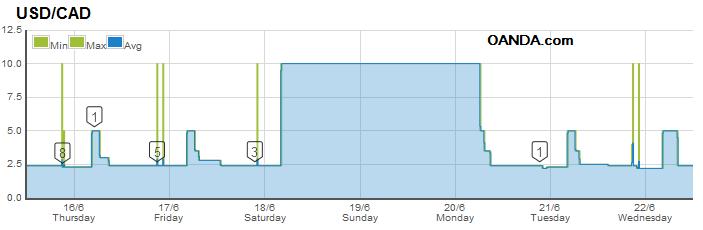
The only way around this is to shift your time horizon from minutes to days – or even weeks. This way, it won’t matter when you have time to trade. Spreads might be marginally higher (as evidenced in the spikes in he chart above, which shows how spreads fluctuate over time) for the USD/EUR at midnight than at 8am, but if you’re planning on holding the pair for more than 10 seconds (and your target profit is greater than 15 pips), this is basically irrelevant.
This way, you also don’t have to worry about carefully planning your entry and exit into positions. Entering a swing trade with a targeted profit of 500pips is probably just as good at 4am as it is at 7am, all else being equal. While this doesn’t necessarily increase the odds of success (above 50%), at least it gives you a great deal more flexibility in being a part-time trader.

Forex Volatility Continues Rising
This week witnessed another flareup in the eurozone sovereign debt crisis. As a result, volatility in the EUR/USD pair surged, by some measures to a record high. Even though the Euro rallied yesterday and today, this suggests that investors remain nervous, and that going forward, the euro could embark on a steep decline.
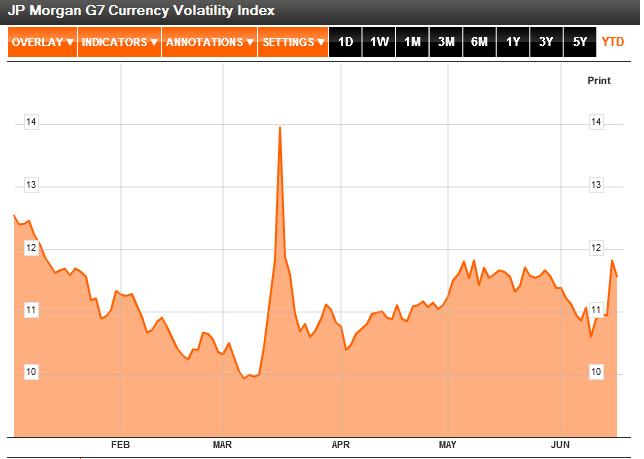
There are a couple of forex volatility indexes. The JP Morgan G7 Volatility Index is based on the implied volatility in 3-month currency options and is one of the broadest measures of forex volatility. As you can see from the chart above, the index is closing in on year-to-date high (excluding the spike in March caused by the Japanese tsunami), and is generally entrenched in an upward trend. Barring day-to-day spikes, however, it will take months to confirm the direction of this trend.
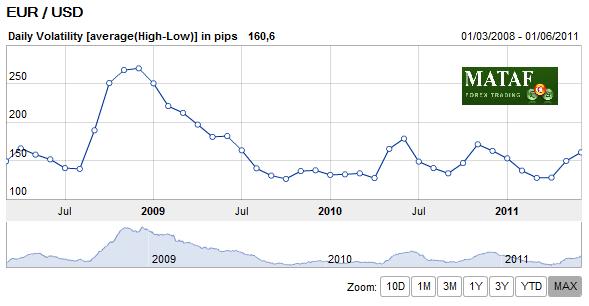
For specific volatility measurements, there is no better source of data thanMataf.net (whose founder, Arnaud Jeulin, I interviewed only last month). Here, you can find data on more than 30 currency pairs, charted across multiple time periods. You can see for the EUR/USD pair in particular that volatility is now at the highest point in 2011 and is closing in on a two-year high.
Meanwhile, the so-called risk-reversal rate for Euro currency options touched 3.1, which is greater than the peak of the credit crisis. This indicator represents a proxy for investor concerns that the Euro will collapse suddenly, and its high level suggests that this is indeed a growing concern. In addition, implied volatility in options contracts has jumped dramatically over the last week, which confirms that investors expect the euro to move dramatically over the next month.
What does all of this mean? In a nutshell, it shows that panic is rising in the forexmarkets. Last month, I used this notion as a basis for arguing that the dollar safe-haven trade will make a come-back. This would still seem to be the case, and should also benefit the Swiss Franc, which is nearing an all-time high against the euro. Naturally, it also implies that forex investors remain extremely concerned about a continued decline in the euro, and are rushing to hedge their exposure and/or close out long positions altogether.
Mataf.net suggests that this could make the EUR/USD an interesting pair to trade, since large swings in either direction will necessarily create opportunities for traders. While I have no opinion on such indiscriminate trading [I prefer to make directional bets based on fundamentals], I must nonetheless acknowledge the logic of such a strategy.

ليست هناك تعليقات:
إرسال تعليق